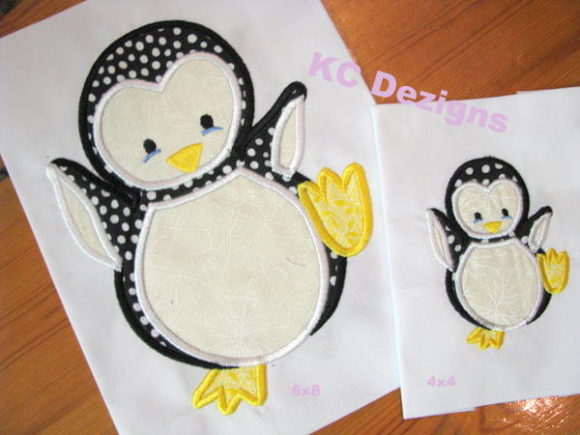
Polar Penguin Applique
A Designer’s First Glance: Charming, Clean, and Quietly Clever
Opening the Polar Penguin Applique file feels like unboxing a tiny winter story—soft curves, rounded silhouette, and that unmistakable tilt of the head that says “curious, not cartoonish.” This isn’t a busy, hyper-detailed wildlife portrait. It’s a machine applique embroidery design built for clarity at small-to-medium scales: think 3–4 inches tall on a baby onesie or 5 inches across a linen tea towel. The shape reads instantly—no squinting, no decoding—and that’s gold when you’re stitching for real customers who want charm, not confusion.
Where It Lives Best: Real Projects, Not Just Mockups
Last week, I stitched Polar Penguin Applique onto a heavyweight organic cotton tote for a local nursery boutique. We used white fleece backing and navy denim fabric, with light tear-away stabilizer underneath. The result? A crisp, dimensional penguin that held its shape through washing and daily use—no puckering, no fraying edges. That tells me this design has smart applique layering: clean cut lines, well-placed satin stitch borders, and fill stitches that don’t overwhelm the fabric’s breathability.
It shines on items where warmth and whimsy intersect: baby blankets (stitched near the corner, not centered), sweatshirt cuffs, reversible aprons, and holiday-themed kitchen towels. I also tested it as an embroidered patch on twill fabric—cut out cleanly after stitching, fused to a denim jacket sleeve. Customers responded immediately: “Oh! That little guy!” Not “What *is* that?” That kind of instant recognition is rare in Wild Animals embroidery—and invaluable for Etsy sellers building brand consistency.
Where It Needs Thoughtful Handling
This isn’t a one-size-fits-all embroidery file. On thin or highly stretchy fabrics—like lightweight jersey tees or ribbed baby bodysuits—I recommend testing with medium-weight cut-away stabilizer. The penguin’s rounded belly and beak rely on stable tension; without proper support, those satin-stitched curves can ripple or distort.
Curved surfaces—caps, beanies, or pillow gussets—require extra attention. The design’s balanced proportions help, but I’d avoid placing it too close to seams or high-traffic bends unless you’ve verified hoop clearance and fabric drape. And on dark fabric? Don’t skip the test stitch in your final thread palette. Some lighter thread combos lose definition in the beak or eye detail. A subtle gray or charcoal satin stitch often reads cleaner than stark white on navy or charcoal.
Also worth noting: while Polar Penguin Applique avoids fussy interior details (no tiny feet, no feather texture), the eye and beak are distinct enough to benefit from contrast. If you’re using it for commercial embroidery—say, branded merchandise for a zoo or early-learning center—confirm your thread colors hold up under repeated laundering. Running stitch outlines around key shapes? Optional, but they add polish on finished products meant for gifting.
Design Notes Every Embroidery Professional Should Check
- Test first on scrap fabric—especially if pairing with textured weaves like terry cloth or bouclé.
- Review stitch density before scaling beyond 120%—dense fill areas can stiffen lightweight garments.
- Confirm hoop size compatibility with your machine. If you’re working on smaller hoops (e.g., 4x4"), check whether the design fits comfortably—or if you’ll need to split or simplify.
- Inspect small details at actual stitch-out size: the beak tip and eye highlight should remain legible, not merge into a blob.
- Try black-and-white mockups before finalizing color palettes—this reveals contrast issues invisible on screen.
- Use appropriate stabilizer: light tear-away for stable wovens, cut-away for knits, and fusible + tear-away for layered applique on fleece or flannel.
- Verify licensing terms before selling finished items or bundling Polar Penguin Applique into digital embroidery bundles—it’s a machine applique embroidery design intended for real-world use, but rights vary by seller.
Why It Elevates Your Handmade Product—Without Extra Effort
There’s a quiet professionalism in Polar Penguin Applique. It doesn’t shout. It doesn’t clutter. It simply *works*—across baby embroidery, custom apparel, holiday embroidery, and small shop product lines. When customers see it on a personalized gift—a monogrammed pillow cover with the penguin tucked beside the initials—they don’t just register “cute.” They register care, intention, and craftsmanship.
That perception lifts perceived value. A $28 embroidered tea towel feels like a keepsake, not a craft fair impulse buy. An Etsy listing featuring Polar Penguin Applique alongside soft pastel thread swatches gains trust faster—because the design signals reliability, not randomness. For creative entrepreneurs building a cohesive line (think: polar-themed nursery decor or winter market collections), this embroidery file becomes a flexible anchor—not a novelty, but a quietly versatile design asset.
Final Thought: A Design That Serves the Project, Not the Other Way Around
Polar Penguin Applique won’t solve every embroidery challenge—but it solves the right ones. It’s not trying to be a photorealistic portrait or a dense floral motif. It’s a focused, functional, friendly machine applique embroidery design built for real hands, real machines, and real customers who choose handmade because they value clarity, warmth, and quiet confidence. Whether you’re prepping for a craft fair, updating your digital embroidery file library, or designing a boutique’s holiday collection, this penguin earns its place—not as filler, but as finish.